
If you are reading this blog, you are probably finding your home too warm for comfort in the summer months. If you have already tried everything else (for example, solar control window film, shutting blinds, installing shutters etc.) but are still finding your home too warm for comfort then you may be wondering what else you can do to cool your home.
With so many of us hybrid working, home comfort (in all seasons) is more important than ever.
Let’s explore your options.
Air conditioning vs heat pump
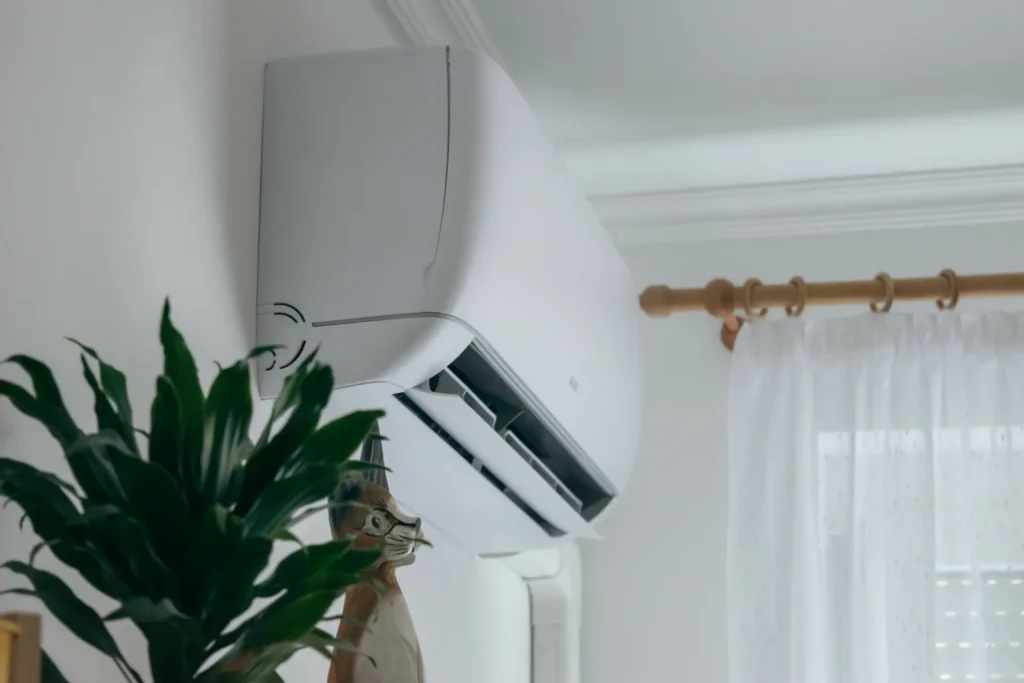
An Air Conditioning (AC) unit is one option you may be considering, but what about an Air Source Heat Pump (ASHP) for cooling as well as heating?
And can’t some AC units heat as well as cool? In this blog we have set out some of your options.
AC unit with a heating function & ASHP with a cooling function: key differences
If both systems are designed to heat and cool air, there is little difference between them, as they both operate using a compressor to heat and/or cool air.
There is no significant difference in efficiency or running costs. In both cases one external unit can deliver heated or cooled air to one or more internal units.
It is only when an ASHP is set up an air-to-water system (linked to radiators and/or underfloor heating) that the difference becomes significant.
Whole home heating with air-to-water ASHPs
This is because an air-to-water ASHPs designed to provide heating to the whole home – as a replacement for a gas boiler or other whole home heating system. This contrasts with an AC or air-to-air ASHP which are designed to provide heating or cooling to one or two rooms only.
Cooling effectiveness with modern air conditioning units
Although both an air-to-air AHSP and an AC systems can be set to deliver the same amount of cooling, the AC is more likely to do this effectively due to the high turnover of air.
A modern AC may also come with air filtration and purification, which is of benefit to those that suffer from summer allergies. Conversely, a ASHP maybe better than an AC at reducing humidity, making it able to run more efficiently.
Risk of condensation
Using an air-to-water ASHP to deliver cooling can be problematic. There is a risk of condensation on radiators and pipework (with the potential for damage and slip hazards) and is likely to be slower to bring temperatures down (relying on conduction, rather than convection).
Fan convector radiators
Fan convector radiators can be installed (which blow air over a heat exchanger), but these require power to operate, adding to the cost.
Heating
Both an air-to-air ASHP and AC units designed to cool and heat, can provide heating to one or two rooms, but not usually the whole home.
For the delivery of whole home heating, an air-to-water ASHP is usually the better option. This is because the capacity of water to hold energy is much higher than air, making the distribution of even temperatures simpler, without the same movement of air and potentially, the noise of fans.
At set out in in our blog on getting hot water from an ASHP it is also possible to use a heat pump to meet hot water needs as well.
Hybrid ASHPs that have both an air-to air and an air-to-water system
These are available. Depending on the manufacturer these ASHPs are known as Variable Refrigerant Flow (VRF), Variable Refrigerant Volume (VRV) or Time Division Multi (TDM).
The more sophisticated of these can deliver heating and cooling at the same time. This is useful if you want hot water and air cooling simultaneously.
Currently better known in commercial settings, such as hotels, this kind of heat pump is becoming more common in domestic settings.
Cost of installing air conditioning vs ASHP
Typically, the cost of installing Air conditioning is less expensive than an ASHP. This is even though the ASHP has a cheaper indoor unit.
This is because the external unit of an AHSP costs more than the external unit of an AC and because the installation of an AC is more straightforward.
The capital cost of an air-to-water ASHP unit is considerably higher than the cost of an air-to-air ASHP. However, the installation costs for both types of ASHP are quite similar if you have existing ducting for air that can be used by the air-to-air ASHP or can use existing radiators for an air-to-water ASHP.
Boiler Upgrade Scheme (BUS)
As AC units are not true heat pumps as defined in the UK and therefore they are not eligible for any incentives under the Boiler Upgrade Scheme (BUS).
This scheme provides grants of £5000 for the install of air-to -water AHSPs providing they provide both space heating and hot water and can provide all the heating and hot water demands of the property. Air-to-air systems are not eligible.
Air conditioning heat pump: Summary
If you have tried, without success, everything else to keep your home cooler, then an AC unit is likely to be what you need.
This will impact both your electricity bill and your carbon footprint, unless you either buy in renewable electricity or (even better) have a solar PV system installed.
An air-to-air ASHP could also provide cooling, but the installation costs are likely to be higher and it may not be as effective as an AC unit at providing cooling.
An air-to-air ASHP is only worth considering if you have one or more rooms that need heating as well as cooling (although some AC units can do this to.
An air-to-water ASHP is an alternative, usually renewable, source of heat for the whole home.
It is not designed to provide cooling, although some hybrid systems may be able to provide this. With the current availability of the BUS, an air-to-water heat pump is well worth considering by anyone considering the replacement of their existing heating system.
Enhancing home’s energy through retrofitting
If the idea of enhancing your home’s energy efficiency through strategic retrofitting and delving into the realm of low-carbon alternatives intrigues you, then our SuperHomes project could be a perfect match.
Our community members are at the forefront of redefining sustainable living. For further details, feel free to visit www.superhomes.org.uk
Want to learn more?
High-Temperature Air Source Heat Pumps – A Good Or Bad Idea?
What Are The Space And Location Requirements Of An Air Source Heat Pump?