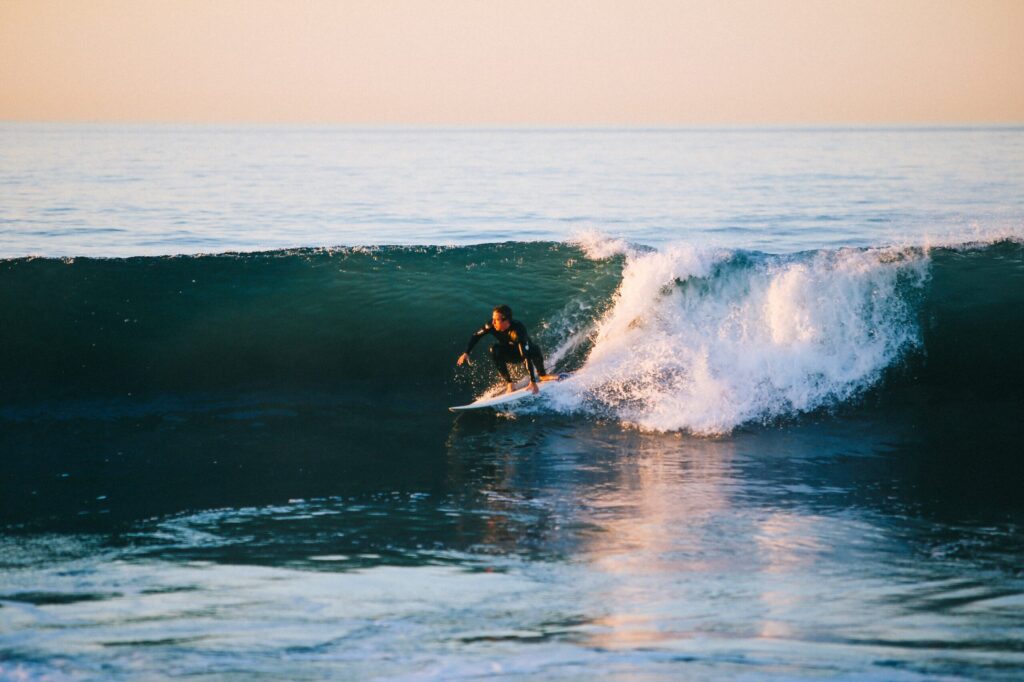
Growing up I could think of nothing more exciting than a trip to the beach to go surfing. I soon became obsessed with the feeling I got from riding a wave and was constantly drawn to spending as much time in the ocean as possible. For me, surfing enables a certain level of escapism and freedom from the stresses of everyday life, as the activity has been shown to have considerable physical and mental health benefits.
There is clear evidence indicating a positive link between experiences in nature and the environmental attitudes a person has. Dr Kathryn Lovering, an NHS-assigned clinical psychologist, found that surf classes help foster positivity among children and young adults, and also help to increase their sense of personal wellbeing. In order to increase pro-environmentalism, researchers encourage people, particularly children, to spend as much time as possible at one with nature. However, this may not necessarily be through surfing. Can you think of a time when you felt most connected to nature?
I believe my passion for protecting the environment stemmed from these positive childhood memories and experiences in the natural world. I have been lucky enough to travel to many locations throughout Europe and Africa to pursue my passion for surfing. Through this, I have witnessed extreme contrasts in the levels of pollution in the marine environment. I have seen unnaturally brown waters, raw sewage running straight into the ocean and beaches that were once untouched by mankind plagued with plastic. This instilled a deep responsibility within me to protect the environment. I strongly believe that this is what shaped my educational pathway, particularly during my years at university. This inspired me to study Geography and go on to complete a master’s in Coastal and Marine Resource Management, with my final dissertation project focussing on the perception surfers have of the environment.
Surfers often have a strong connection to the marine environment and a responsibility to protect it, with very few people getting to travel to as many exotic and naturally pristine areas of coastline. As stated in the encyclopedia of surfing ‘the vast majority of surfers have proven to be dormant environmentalists at best, supporting the movement in abstract, but for the most part roused to action only for a pressing local concern that might despoil their beach’. In many coastal communities around the world, surfers are the primary form of tourism and therefore, a vital form of income for local people. In most cases travelling surfers are highly respectful towards the local community they are visiting, however, there are exceptions. Surfers can often be incompletely aware of their impact on the environment taking regular flights, consuming environmentally damaging surf products and using excessive amounts of natural resources. They can also exhibit irresponsible attitudes towards the local communities resulting in tensions arising between visiting surfers and local communities.
Nevertheless, the positive influence of surfers on the environment can be seen on a global scale. A study in New Zealand in 2011 focused on both the spiritualism and the level of environmentalism amongst the surfers demonstrating that participation in marine activity often results in strong advocacy for the protection of the marine environment. Internationally designated ‘World Surfing Reserves’ are used to protect local ecosystems for surfers and provide influence for wider conservation efforts. Surfing reserves can be seen across the world from Ericeira in Portugal to The Gold Coast in Australia and Huanchaco in Peru. Surf spots in general have proved to be highly emotive, particularly along Peru’s extensive coastline. Surfers there have gone to extreme measures to protect their local beaches and ecosystems, and have been seen to stand in the way of machinery whenever large-scale construction projects have been imposed. They also exampled as strong campaigners and activists, resulting in the formation of numerous conservation-based charities. A prime example is the Cornwall-based Surfers Against Sewage, which formed in 1990. They are a decentralised community-based charity dedicated to protecting oceans, waves, beaches and wildlife. Surfers from the local community were roused to action, appalled by the state of their beaches, often finding themselves swimming in raw sewage or amongst human waste. Without the action of these charities, the health of our oceans would be far worse than they are today.
The planet’s marine ecosystems continue to decline at an alarming rate. As a result, it has become extremely important that we act now in order to save the future of our natural world. Coral bleaching, overfishing, sea-level rise, pollution and loss of biodiversity all pose a considerable threat to our oceans. It is essential now more than ever to spend time outdoors and immerse yourself in nature as it can build important relationships with the natural world and help to shape pro-ecological attitudes. My personal experiences have created a passion to learn more about the world we live in and preserve it so that future generations can do the same. I hope that through sharing my experience people feel encouraged to do the same and feel a responsibility to do something about our uncontrolled destruction of the natural world. I believe that prioritising the conservation of nature will help to shape a better future for us all and the planet that we call home.