


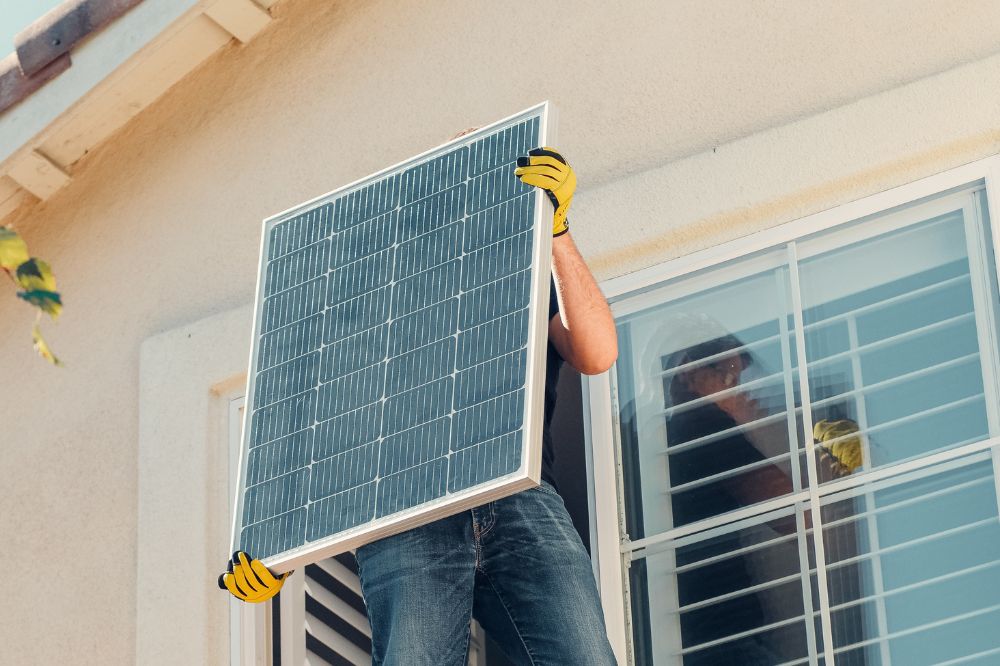
If you’ve started looking into an investment in solar PV for your home, you’ll already know that there are several factors to consider. In this blog, we’ll take a run through the most significant, with a view to helping you decide if you want to take the next step and start speaking to installers.
Cost
The cost of solar PV has come down significantly since the launch of the Feed in Tariff (FIT) in April 2010; a fact sometimes overlooked by potential buyers who look with envy at the income being earned by these early adopters from the FIT.
As you are probably aware, solar PV panels are best placed on a south-facing roof, with no shading from chimneys or nearby trees. For most domestic properties, the size of the array likely to fit is likely to be between 2.5 to 4kWp (kilowatts peak). According to Government’s solar PV cost data the average cost per kWp of a solar PV system between 0-4kWp in 2022/23 was £2,365 per kWp. On this basis, a 4kWp array would set you back £9,460.
Despite the reduction in VAT on a solar PV install (from 5 to 0%) in April 2022, this is an increase of 26% on the average price for 2021/22 (due to inflation, supply issues and high demand). Although prices do seem to be falling again, it may be a little while before prices are back to what they were a couple of years ago.
Are there any grants?
You may have seen adverts for free solar PV. A closer look reveals that the grant being referred to is funding from a Government initiative called ECO 4. This is designed to support those on benefits and even for them solar PV funding is only for those living in an electrically heated home. If you are within this group, it is worth contacting an energy supplier (it doesn’t have to be the supplier you purchase your energy from) to find out what they can offer you.
If you are outside this group, you are unlikely to be able to get any grant funding toward the cost of solar PV, although it’s always worth checking with your Local Authority for local schemes.
Savings on electricity bills
Several factors will affect the amount of electricity that will be generated by a solar PV array. These include size, orientation, angle, shading and geographical location. In the UK the range is between 700 and 900kWh per annum per kWp. A kWh (kilowatt hour) is the same as a unit of electricity. If you have a 4kWp array producing 800kWh per kWp, it will generate 3,200kWh of electricity. This is enough to provide all the electricity needs of an average three-bed home in the UK (but not always when you need it i.e., at night and in the winter – so electricity will still need to be imported from the grid).
Although electricity prices have started to fall (from 32p per kWh to around 29p per kWh from July 1st, 2023) savings on electricity bills (and cushioning oneself from any future price hikes) are significant factors in the decision whether to invest in solar PV. Even if only half the electricity was used directly in your home, that is still 1,600kWh at 29p a unit, a saving of £464 a year.
Without battery storage (more on this later), the amount that can be saved will depend on how much of the electricity is used while the solar electricity is being generated. Charging an electric vehicle or using a solar immersion controller/power divertor to divert surplus electricity to produce hot water (only possible if you have a hot water cylinder) are two ways of maximising the use of solar electricity within the home rather than exporting it back to the grid. Behaviour change can also help – for example, putting the dishwasher or washing machine on during daylight hours will also reduce the amount of grid electricity imported.
Battery Storage
If you are not around in the daytime to use the electricity being produced from your solar PV another option is to store the surplus electricity in a battery. As you might expect batteries come in various sizes and price tags, depending on the storage capacity required. Further information on battery storage can be found on our SuperHomes website and in this article from Which?. Given the substantial additional cost (which might be as much as 50-100% on top of the installation costs of a solar PV system) investing in battery storage is not a decision to be taken lightly.
Smart Export Guarantee (SEG)
Without a battery, you will inevitably be exporting some of the electricity generated from your solar PV array back to the grid. Introduced in January 2020 the SEG is a mechanism for ensuring that owners of solar PV systems are paid for surplus electricity exported back to the grid. To qualify for the SEG it is necessary to have a second-generation smart meter.
All energy suppliers with over 150,000 must offer a SEG, that must be at a higher than zero. While you don’t have to sign up for a SEG with your current electricity supplier, you may find that you’re able to get a better rate if you do. As with all things, it pays to shop around for the best deal. Helpfully, this has been made easier by Solar Energy UK, a trade association for the solar industry. Their website has a handy league table of the SEG rates being offered by all the big energy suppliers.
Lifespan
Solar panels will generally generate electricity for around 25 to 30 years, although there may be a slight drop off in performance after the first year or two. The panel manufacturer’s datasheet will tell you how long the warranty is and how much electricity you can expect each panel to generate.
Impact on house value
In 2021 Solar Energy UK published their report (The Value of Solar Property) on the increase in sale price of homes fitted with a solar PV system compared to those without. Their finding was that a typical home with solar PV achieved an increase in sale price of £1,800. Although less than the cost of having the system installed, this is helpful, particularly for those who sell prior to breaking even on their investment. The report provides a further breakdown by property types and geographical location and is well worth a read for anyone who wants to know more about this subject.
Further information and advice
The Energy Saving Trust has a useful calculator which will provide you with some initial information on the likely output from a solar PV array on your home, carbon dioxide savings, fuel bill savings and payments from the SEG.
Of course, this blog is no substitute for getting quotes tailored to your home and advice from a qualified installer about the likely yield of solar electricity from an array installed on your home and the ins and outs of battery storage and/or a solar immersion controller etc. For this, we recommend a search of the Microgeneration Certification database to find contractors who work to industry recognised standards and use certified products.
Summary
By its very nature, this blog can provide only a brief overview of the factors to consider when deciding on an investment in solar PV. Only by getting quotes, with and without battery storage and looking at how much electricity is used in your home (and when) can you begin to know whether an investment in solar PV, made on financial (rather than environmental) grounds is worth it.
Added to this are the unknowns around future energy prices, SEG rates and the impact on installing solar PV on the value of your home. However, for anyone with a suitable roof, who plans to stay put for at least 5-10 years and a desire to protect themselves from future increases in energy prices, solar PV is worth serious consideration.
If the idea of enhancing your home’s energy efficiency through strategic retrofitting and delving into the realm of low-carbon alternatives intrigues you, then our SuperHomes project could be a perfect match. Our community members are at the forefront of redefining sustainable living. For further details, feel free to visit www.superhomes.org.uk





