


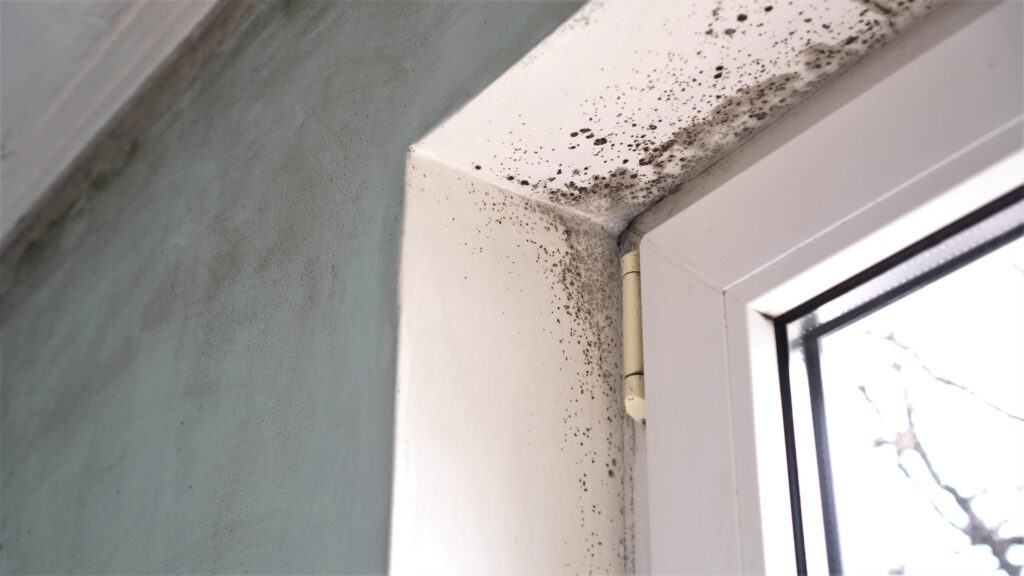
Nobody likes to see mould growing around their home, particularly when it keeps coming back in places where it’s been removed before. It looks unpleasant and has serious health risks, particularly for the very young and old and those with chest conditions like asthma.
Coming up with a permanent solution for the eradication of mould around the home requires an understanding of the conditions that allow mould to thrive and tackling the cause rather than the symptoms. This requires cooperation between the owner and the occupier – not difficult when they are one and the same person, but much harder when the home is let. All too often the tenant will blame the landlord for poor maintenance and the landlord will blame the tenant for the way they are living in the property. As we will see, it’s only by working together that a long-term solution can be found.
What conditions does mould need to grow?
For mould spores to reproduce they need warmth, nutrition (for example, wood or paper), oxygen, and moisture. Within homes, the main limiting factor for the growth of mould is the presence of moisture. Generally, a damp environment favours mould growth. At a relative humidity of above 70% mould will grow.
Moisture is released when warm air meets a colder surface. This often happens in kitchens and bathrooms but can also happen elsewhere, particularly in the corners of rooms and sloping ceilings (where there is less insulation). Mould can also occur where there is less ventilation e.g., behind furniture or where there is raising or penetrating damp, due to the likes of broken or damaged gutters and pipes.
What can be done to prevent the growth of mould?
There are several things that can be done to prevent the growth of mould. Jobs for the landlord include:
- Ensuring that any repair jobs, like replacing missing tiles, fixing gutters, downpipes etc. are completed quickly to stop unwanted moisture from causing damage to the building.
- Improve the insulation of the building so that the internal temperature of external walls, floors and top-floor ceilings is warmer. This could be done through cavity wall insulation or internal or external wall insulation (depending on the construction type), top-up loft insulation to 270mm thickness etc.
- Provide the tenant with means to ventilate the property properly. This means windows with trickle vents and extractor fans in wet rooms like kitchens and bathrooms. Better than a manually operated extractor fan would be a humidistat, which will turn on automatically when high moisture levels are detected.
- Providing an appropriately sized dehumidifier to keep humidity levels below 50% and a humidity monitor to measure this.
Jobs for the tenant include:
- Letting the landlord or their agent know as soon as any disrepairs are noticed.
- Making use of the ventilation systems provided – turn on manual extractor fans when cooking or bathing and let air circulate throughout the house. Open windows on dry days to allow fresh air in
- Drying clothes outside, if possible, not on radiators
- Heating the whole home – unheated rooms are much more likely to suffer from mould. Generally recommended is 21 degrees for the living space and 18 degrees for bedrooms.
- Immediately wiping up spillages and wet areas before mould gets a chance to establish itself (which can take as little as 24-48 hours).
- Move furniture away from walls, particularly external ones.
- Making use of any dehumidifier and humidity monitor provided by the landlord.
What can I do to get rid of mould, at least on a temporary basis?
As indicated previously, getting rid of mould on a permanent basis requires addressing the underlying cause(s). Without this, any mould removal is likely to be temporary only.
There is lots of advice and tips on the removal of mould on the internet. Common to them all is the need to wear protective clothing – long rubber gloves, protective eyewear and a face covering to limit exposure to the spores that will be released as you clean. Also advised is shutting the door to the room you are working in and opening the window/vents. Surfaces should be wiped, not shrubbed to reduce the chance of releasing spores into the surrounding air. A solution of diluted bleach is frequently mentioned – one part bleach to three parts water and undiluted vinegar sprayed on the wall. Several proprietary products are also available.
For large areas calling in a mould removing expert is advisable.
Want to find out more about what insulation may be right for you and your property? Our article on internal vs external insulation may be exactly what you are looking for.
If you’re interested in finding out more about what you can do to insulate your home, or maybe need someone to talk to, Better Housing Better Health can help with free impartial advice. Click here to find out how they could help you.





