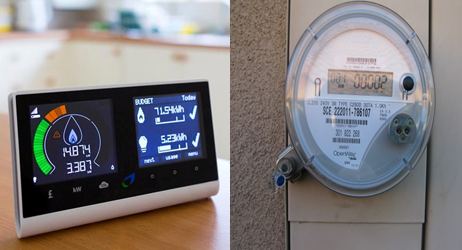
A smart meter can provide you with a detailed breakdown of your gas and electricity usage and costs in real time, best viewed through a linked in-home display. The meter puts an end to the laborious process of estimated billing by feeding your supplier your usage data automatically, meaning you no longer will have to provide your own manual meter readings. The in-home display reveals your gas and electricity consumption to improve your knowledge of how much you’re using and can be programmed to display this information in relation to your chosen tariff, e.g. Economy 7.
If you pay by direct debit, you will be billed much more accurately based on your actual usage during the past month or quarter. If you’re on a pre-payment meter, a smart meter will open up more flexible ways of topping up your meter, e.g. on your mobile or online. You’ll also be less likely to unknowingly run out of credit, as you can see how much you’re using and you can even set your meter to automatically top up, so you won’t be left without power if you run out of credit and the shops are shut.
So what’s the catch? We know that smart metering technology is not without controversy. We will address four concerns raised with us by YouGen readers.
- Can I still switch energy supplier?
There are two types of smart meters in circulation, the majority of which are ‘first generation’ or ‘SMETS 1’ devices. The key problem with these models is that when you want to switch energy supplier, your new supplier cannot read the data from your smart meter, meaning it becomes a ‘dumb’ meter again and you have to provide manual readings. Or, you can have a new smart meter installed entirely by the new supplier after you’ve switched (assuming you want one and they provide them).
According to reports, energy suppliers are still installing these old SMETS1 models. To minimise the likelihood of ending up with one, you could always specify when asking your supplier that you’d like a ‘second generation’ or ‘SMETS2’ meter. Your supplier is obligated to say whether your smart meter will be affected if you were to leave them, so make sure to ask them to clarify this.
From January 2019, suppliers will have to stop installing SMETS1 meters and will have install a SMETS2 instead, so if you feel a bit dubious about getting a potentially-obsolete meter installed, it might be worth waiting until next year.
It’s also worth mentioning that first generation (SMETS1) smart meters are expected to be connected to a new national infrastructure scheme run by the Government-appointed Data and Communications Company (DCC) in the first half 2019. This will mean all smart meter owners can change suppliers without losing the smart features, as SMETS1 meters will be able to communicate with a data cloud, enabling you to switch and stay smart with your new provider.
- Will poor mobile or Wi-Fi signal prevent me from installing a smart meter?
Smart meters use an entirely separate, bespoke wireless system to transmit your usage data to your energy company – similar to when you use a card reader for online banking. You don’t need Wi-Fi for it to work and even if you have it, it won’t use it.
Ongoing concerns have been raised by some users about their meter having difficulty connecting to the network, particularly in high rise flats or rural properties. Ofgem state that smart meter communications coverage will reach over 99% of households in Britain by 2020, using a range of technologies, not just mobile signals. To reduce the likelihood of poor signal, ask your supplier whether they’re currently able to install smart meters in your area, to get proof on whether you’ll be eligible.
- How will my data be stored and used by companies?
According to Smart Energy GB, smart meters have been designed by working with top cyber security experts, including the Government and GCHQ. It’s important to remember that your smart meter only stores information about how much gas and electricity you’ve used, NOT personal information that could identify you, such as your name, address or bank account. Of course, your supplier will have this information in order to bill you, but it won’t be transmitted across by your smart meter.
UK energy regulator Ofgem, are very clear about your rights. They state that suppliers can access your daily energy usage data unless you object, but must get your explicit permission to access your data at intervals more frequent than every half-hour, or to use your data for marketing purposes, e.g. to offer you special deals or tariffs in relation to your usage. Gas smart meters can only do readings every 30 minutes, as they are powered by batteries, but a similar agreement in terms of using your data remains in place.
So to be clear, you’re very much in the driver’s seat when it comes to how much of your data will be stored, shared and acted upon. For more information, see the Data Guide for Smart Meters developed by Energy UK and Citizens Advice.
- Will a smart meter work if I generate my own electricity?
Smart meters currently only pass on to your suppler how much energy you’re buying from them, and show you this directly through your in-home display. According to Smart Energy GB the SMETS2 models should be able to communicate with solar panels, and although some SMETS1 models do, this depends on how they’re installed.
However, it’s clear from customer feedback that the two technologies don’t always work in tandem, and energy suppliers we contacted weren’t able to provide a uniform response.
We called one energy supplier in the Big Six who stated that their SMETS2 models would be compatible with their customers’ solar PV. However another supplier indicated that the compatibility would depend upon whether your home had either one or two MPANs (Meter Point Administration Numbers). Based on this lack of clarity and consistency in responses, we strongly suggest you let your energy supplier know that them you have solar PV, prior to the installation of the smart meter. It seems that the compatibility of the two technologies is very much dependent on your individual situation, meaning it’s important to seek advice to reduce the likelihood of difficulties later on.
Some concluding thoughts
It’s worth highlighting that a recent survey showed that 75% of people with smart meters say they would recommend having one installed to their family and friends, with around 82% saying they have taken steps to reduce energy waste after making use of the information provided by the technology.
However as the evidence above shows, it’s not a case of ‘one size fits all’. We encourage you to think carefully about what you seek to gain from installing a smart meter, contact your supplier and consider the points above before adopting the technology in your home.
It’s also worth ensuring that your supplier will supply you with an in home display at the same time as fitting your smart meter and remembering that despite the benefits it’s not compulsory to have a smart meter installed by the deadline of 31st December 2020. Instead your supplier will have to prove to Ofgem that they have taken all reasonable steps to offer you a smart meter (which offer you have refused).Have you had a smart meter installed in your home? Tell us about your experiences in the comments.