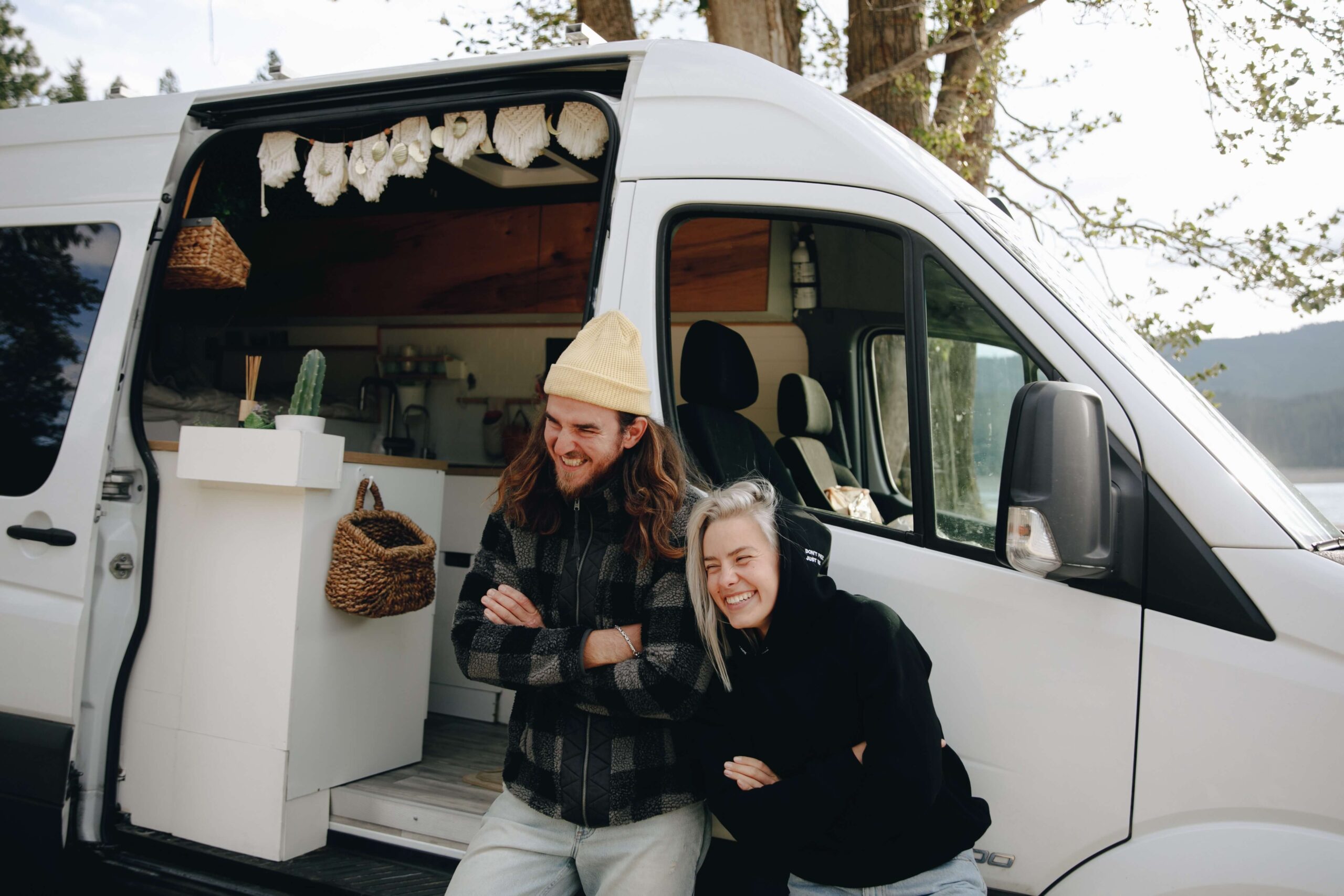
If you’re about to buy yourself a van to convert to use for holidays or to live in, you’ll be aware that you’ve lots of decisions to make. Inevitably, there will be compromises due to space and budget constraints. In all the excitement of planning your getaway vehicle, it is easy to get carried away with layouts and styling. These are the bits you can see and where you get to express your individual style. But before the fun starts there are several energy-related issues that need to be decided, based on how you plan to use your campervan.
Insulation
At its most basic the back of a panel van is simply a metal box. Even if some kind of flooring or paneling has been added, there is no guarantee that there will be any insulation behind it. Whenever you are planning to use your campervan you are going to need insulation – whether that’s to keep the heat in or out. It’s the same as with a house – the more insulation there is the more comfortable you will be inside and the less heating (and potentially cooling) you will need.
In addition, insulation is also good for its acoustic benefits – reducing the amount of noise coming in and out.
When choosing an insulation material, it is important to consider both its thermal conductivity (K-value) and ease of insulation. The lower the K-value the better. Mineral wool insulation has about twice the thermal conductivity of a PIR board, meaning that double the thickness is needed to achieve the same insulation benefits. On the plus side, mineral wool is easier to install on uneven surfaces and curves than a rigid board, although care needs to be taken to ensure that the wool is not squashed (it needs the air trapped in it to work properly).
For any insulation system to work effectively, it needs to be continuous, with no gaps at the joins between the floor, walls, ceiling or anywhere else. Any gaps that are left will result in cold spots (thermal bridges) in the interior of the van, which are likely to suffer from condensation and the growth of black mold. For the same reason, a vapor barrier should be installed over any insulation material that does not already have one, like mineral wool.
Natural insulating materials like hemp and sheep’s wool can also be used, but all will need to be installed at greater thicknesses than mineral wool to achieve the same levels of insulation and is likely to be more expensive.
Aerogel is the thinnest insulation material able to provide low levels of thermal conductivity, but it comes at a price. If internal space is at a premium, it is worth considering – for example, to be able maximise the length of a bed fitted sideways across the campervan.
For more on this topic see The Ins and Outs of Campervan Insulation from Quirky Campers who also produce a book on How to Convert a Campervan.
Heating
If you want to use your campervan when it’s cold outside, you will need a heating system. With low thermal mass, a campervan cools down quickly when the temperature outside drops (and heats up quickly when as the temperature climbs).
The main options for campervan heating are diesel, wood, and gas. Diesel heaters are convenient because the use the fuel from the vehicle’s diesel tank and take up very little space. An added advantage is that they can be used in conjunction with a thermostat, programmer and can be used to heat hot water as well as provide space heating. On the downside, they need a source of 12v electricity to run, are relatively expensive to buy, and are rather noisy both inside and out.
A wood-burning stove is the only renewable option and is cheaper to buy, but must be properly installed, to ensure that there is proper ventilation (to avoid the risk of carbon monoxide poisoning) and that all safety regulations are adhered to, like storing the wood away from the stove. A wood-burning stove can also take up quite a bit of space, particularly if it needs a guard around it to protect young children. It is probably an option best considered for a larger campervan that will be used without young children around.
Gas heating in a campervan is similar to diesel, in that the heat is blown through vents and it can be thermostatically controlled. The fuel source will either be bottled butane gas or LPG autogas, with an underslung tank filling point. The advantage of using LPG autogas is lower running costs; the downside is the higher installation costs of fitting an underslung tank.
A lot more information about heating options can be found in this blog.
Cooling
If you’re planning to go to some hot places in your campervan, there are some additional things to consider. To keep things cooler inside, you will need good insulation – this time to keep the heat out, rather than in. You’ll also want to consider secure ventilation – a fan or air conditioning unit integrated into a skylight is possible, although, for the latter, you’re likely to need an electrical hook-up. More sustainable is opening doors and windows for cross-ventilation, leaving blackout blinds closed and windscreen covers up, and creating shade with an awning if there is no natural shade nearby.
Hot Water
Not all campervans are fitted with running hot water. Some make do with boiling a kettle and showering at a campsite or local pool.
Even without running hot water, a warm shower is still possible on warm days by setting up a solar shower. Just fill the bag and leave it in the sun for a while (ensuring of course the temperature doesn’t get too hot!). If your main use of your van is going to be in warm weather, you might also consider an external shower arrangement off the back doors, rather than trying to squeeze an internal shower in a small space. You’re not going to be cold after all, although you might want an awning or shower tent for privacy.
Electricity
If you are going to be staying mostly on campsites, then it would be sensible to have an electric hook-up fitted, so that you use mains electricity when you want it. Anything that heats using electricity, such as a microwave, oven, toaster, hairdryer, electric shower, or iron requires a lot of power, best met by a mains electrical hook-up.
If you’re staying elsewhere you’re still likely to need some electricity, to run a fridge, to power the electrical side of a diesel or gas heater, to charge phones etc. Fortunately, all these things can be done by using 12v DC electricity provided by one or more leisure batteries, although 12v fridges are much more expensive than mains-powered ones.
Leisure batteries can be charged from the van’s alternator when the engine is running, but better still, if you’re not moving about much is to install solar PV panels on the roof. Even one 200w panel can make a significant difference to the amount of electricity you have available, with the added benefit of keeping your campervan’s engine battery topped up too.
As with so many decisions about your campervan conversion, this is an area where compromises may need to be made – solar panels are likely to be incompatible with a pop-up roof and limit the amount of space available for roof lights, stove flue, and roof top storage.
Summary
Whether you are planning to convert your van yourself or paying someone else to do it there are lots of decisions to be made, some of them easier to reverse than others once the conversion has started. Plumbing, heating, electrical supply, and insulation are all much easier to install before fixtures and fittings are put in place, so it pays dividends to consider how you are planning to use your campervan, ask questions and do your research before you start. There are lots of resources available and groups you can join, such as Facebook groups Self Build Campervans and Van Conversions into Campers and numerous YouTube videos.