Christopher Rawlings,
If I were to say the phrase ‘air pollution’, there’s a good chance the image that’s conjured in your mind is one of a bustling city in a foreign country. Smog in Beijing. Soot in New Delhi. Ozone in Los Angeles. Visibly poor air quality that, globally, causes several million deaths per year. As is well known, natural gas burns cleaner than coal. Carbon dioxide emissions, for example, are roughly 45% lower compared to coal, which is why it’s considered a transition fuel. Burning natural gas also releases fewer pollutants. To see this, you only have to look at images from the Victorian era when people cooked with coal stoves. Soot coated ceilings and walls, and particulate matter rife in the air. However, natural gas also has invisible side effects which was something I discovered for myself.
As someone who lives in a one-bedroom flat with their boiler in the living room/kitchen, I not only have limited room, but my boiler is also prominently on show, a device usually hidden away now unfortunately in plain sight. Worried about general air quality, I convinced myself that a sensible idea would be to buy an air purifier. It was purchased in part because I’m a self-confessed hypochondriac, but also because I live in a built-up area in a new build property, and both of those factors mean the particulate matter from vehicle exhaust fumes, and toxins leaching from the flats construction, are likely to be higher than if I lived in an older house in the country. For most of the time this reasoning is proven to be false. The air purifier which grades from excellent (blue on an LED indicator) to very poor (red on an LED indicator) shows a reassuring blue. However, there are very specific times when an eruption of noise can be heard around the flat, and a disconcerting red shows on the LED indicator. The first time is in the morning after showering. Every. Single. Morning. The second time is anytime we use the hob. Both of these events caught me by surprise. Not much is mentioned about the health impacts of burning natural gas within the home, but as I discovered after exploring the topic, it turns out there’s more than meets the eye.
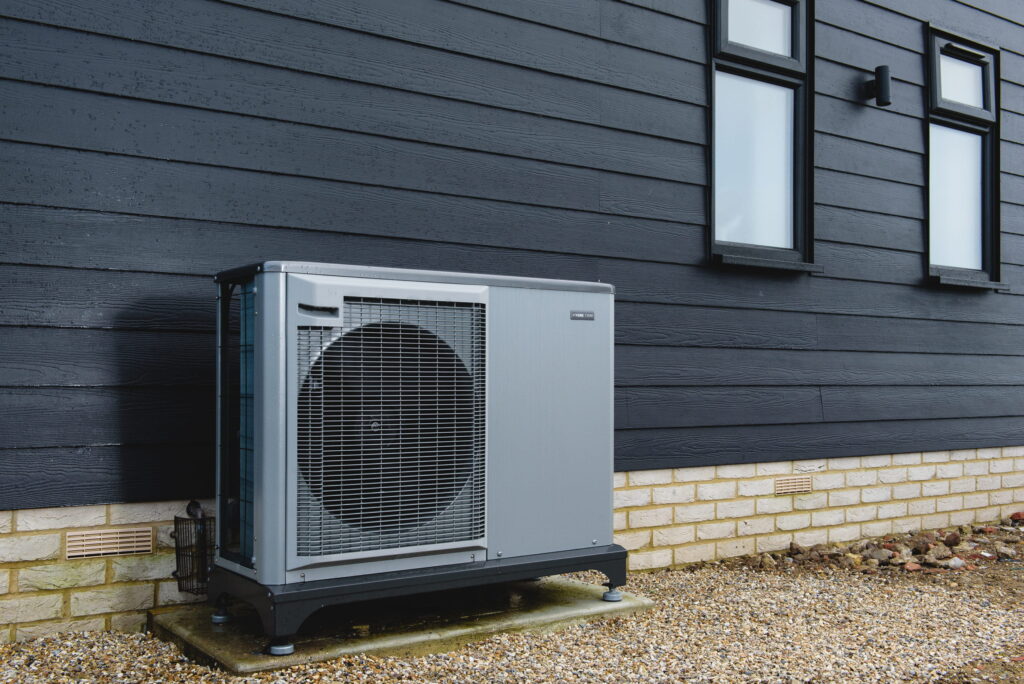
So, what does this have to do with heat pumps? To answer this question, it’s worth considering what’s released when you burn any sort of fossil fuels. Typically, it’s a combination of particulate matter that is a collection of dust and liquids, as well as some other chemicals. Some, like soot, are visible, but the smaller the particle, the more dangerous. You might have come across terms like ‘PM10’ and ‘PM2.5’. In a nutshell, they refer to size, with PM10 being particles around 10 microns or smaller in size, and PM2.5 referring to particles around 2.5 microns or smaller in size. There are others like sulfur dioxide, ozone, nitrogen oxides, benzene and more. When burning natural gas in the home, these are the particles that are released. Benzene and nitrogen dioxide are of special concern, and studies have shown they regularly reach unsafe levels in the home when using gas stoves. These particles can exacerbate asthma, cause irritation, impact the heart, and are particularly damaging to children whose lungs and bodies are still developing. However, swapping to a heat pump, or any form of electrification, removes this source of pollution and with it the damaging effects to human health. In addition, the International Energy Association estimates heat pumps will remove half a gigaton of CO2 emissions by 2030. Not bad. Not bad at all.