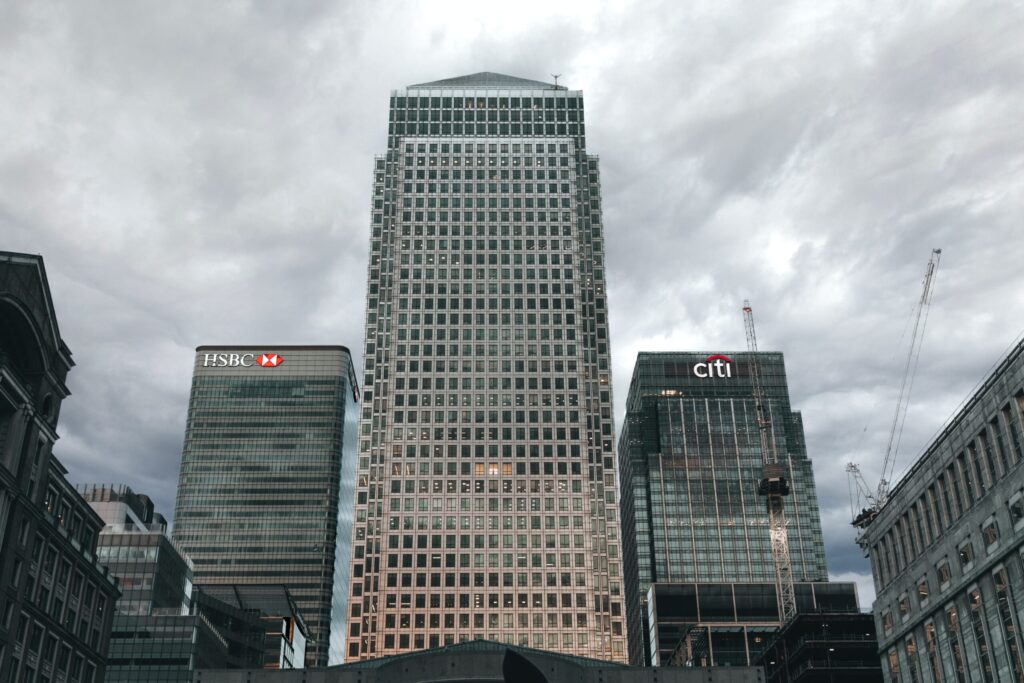
Supporting local businesses and ethical brands are some of many things that individuals can do for a better future, but have you ever thought about the impact of choosing the right bank? Simply letting your money “lay around” in your bank account can have a huge impact on our environment. Banks use your money, whether held in an account, pension or other investments, to loan to or invest in other businesses, which are often not environmentally-conscious. While not every bank subscribes to ethical objectives, there are some that do. Read on to find out what side your bank stands on.
Many of the world’s biggest private banks still chose to invest in fossil fuels. Banks such as HSBC, Barclays, BNP Paribas and the Deutsche Bank, to name a few, continue to contribute to funding the building of oil pipelines. What is interesting about banks like HSBC or Barclays is that their website promotes sustainability and renewable energy, often giving the customers the impression that their money is safely and sustainably invested. A closer look into their history shows that there is more behind the organisation’s claims.
In 2012 HSBC was involved in a money-laundering scandal involving a Mexican drug cartel, simply because the bank was careless enough to ignore the obvious signs that something was wrong. Back in 2012, HSBC’s money laundering program did not meet the standards and left only two compliance officers for about 600 customer accounts. What is more, HSBC is also responsible for processing transactions in Iran, Libya, Sudan and Burman, which is currently illegal. But they are not the only banks engaging in such activities. SCBFF, ING, Barclays or the Royal Bank of Scotland all had to pay fines for facilitating similar transactions throughout the years.
However, it’s not all so bad. There is at least one positive I took from the information I found, which is that HSBC prohibits financing of new fossil fuel expansions. According to HSBC, the Bank is working with its clients to achieve a transition toward a low carbon economy. Barclays even set a target of a 15% reduction in financed emissions from energy, including coal, oil and gas by 2025. While critics say there is little evidence so far that those claims are being acted upon, only time will tell of the outcomes of these ambitions.
The most sustainable banks
We as customers cannot ignore the uncomfortableness of this world. Sometimes it takes time to find the right choice, especially when the Bank you chose makes it hard for you to find the truth. To help you make a quicker decision when it comes to sustainable banking there is an easy tool you can use. The Website bank.green can provide you with a report on your bank´s fossil fuel record based on your geographical location. Unfortunately, not every bank is yet listed on the website. HSBC and Barclays are listed and with no surprise they are both listed as red, meaning they invest in fossil fuel expansion.
It is not up to you as an individual to change what big companies do or fight the climate crisis alone, although it can be an easy way to make a change changing your bank to an ethical bank. There are a few banks across the UK with each of them supports their own unique and special projects where you might find your own values represented. A rather refreshing first start when looking into ethical banks is their transparency towards where your money is invested in. Have a look below and choose your bank!
Triodos Bank: “banking can be a powerful tool for good”
Triodos Bank is a financial banking service for savers, investors and entrepreneurs with the goal to connect these groups. Its mission is to make money work for a positive social, environmental and cultural change! The bank finances only sustainable projects – from helping disadvantaged groups to social housing and renewable energy projects. The bank’s capital is used to finance its growth so that it can the money can later be lent to a wide range of inspiring ethical organisations. “We strive for a sustainable, transparent and diverse financial sector that makes money work for positive change” (Triodos Vision and Impact). You can find out more about the projects Triodos Bank is investing in here.
The Co-Operative Bank: best ESG Rating
With a score of 9,2 the Co-Operative Bank has the best Environmental, Social and Governance (ESG Rating) ratio of any high street bank in the UK and is now recognised by independent experts Sustainalytics. They stopped financing fossil fuels in 1998 and since 2007 they are completely carbon neutral. The Bank works toward being a long-term, sustainable business that makes a positive difference to the communities and does not provide banking services to organisations that are involved in conflicts in human rights, contribute to environmental degradation, abuse animal welfare or those who act irresponsibly. What is more, the Co-Operative Bank supports the third sector by providing free banking for charities, contributing to working towards the end of youth homelessness, fighting against abuse and defending human rights.
Ecology Building Society: “We use your savings to make a positive environmental impact”
Their vision is a fair society in a sustainable world by enabling sustainable building and communities. The Ecology Building Society´s values fairness, open-mindedness and being responsible towards the people and the planet. To improve the environment, they support and promote ecological buildings, renovations and sustainable community projects. They specialise in providing mortgages for charities, voluntary organisations and community groups that support the environment or deliver benefits to local communities. On their website, you can find the customer projects and the story of their sustainable building.
Charity Bank: “Uses your money to lend to charities and social enterprises”
The Charity Bank lends money to charities, social enterprises and organisations tackling social and environmental issues. By helping charities like TRESOC, a community group with the aim of developing renewable energy resources in their local area, the loan of the Charity Bank helped TRESOC to expand their solar portfolio to support a local dairy farm. The money helped the farm to archive an extra annual income through saving electricity costs. Other charities like the Independent Cinema Office Group, the Big Creative Education Community or the YMCA Black Country Group are all charities in different sectors, though they all found support from the Charity Bank when they
couldn´t find it elsewhere. The bank shows people how their savings could be invested ethically while also contribute towards bettering the lives of local communities.
Banks that see their customers moving elsewhere because of climate concerns, sustainability and community are more likely to cut down on fossil fuel investments or unethical investments. By removing your savings from the bank, you help stop their supply of money to spend on unethical investments. Make it a journey of learning and exploring the world of money and the influence you can have! Find out your true beliefs and values, see the importance of each one and try to make a small change every day.